
What is tennis elbow?
Tennis elbow (lateral epicondylitis) is a painful overload condition of the tendons that anchor the forearm’s extensor muscles to the outside of the elbow. Despite the name, most people who get it don’t play tennis — repetitive gripping, lifting or computer work are more common culprits.
Common symptoms
- Pain and tenderness over the bony prominence on the outside of the elbow
- Pain with gripping — shaking hands, lifting a kettle, turning a doorknob
- Aching into the forearm after activity
The good news
Tennis elbow is usually self-limiting: the great majority of cases resolve within 12–18 months with simple measures. Treatment aims to settle pain and speed that process up.
Non-surgical treatment
- Activity and load modification — reducing the aggravating grip-and-lift pattern
- Physiotherapy with a graduated strengthening (eccentric loading) program
- A counterforce brace worn just below the elbow
- Judicious use of injections — repeated corticosteroid injections are discouraged as they can worsen long-term outcomes
Tenocyte injections for persistent tennis elbow
Autologous tenocyte implantation (ATI) uses tendon cells taken from your own body. Dr Melsom’s approach, described in the GP information sheet below, takes a small tendon sample from the wrist, using palmaris longus or flexor carpi radialis (FCR). Orthocell isolates and grows the cells over approximately six weeks, before they are injected into the affected elbow tendon under ultrasound guidance.
Tenocytes are mature tendon cells, not stem cells. ATI is also different from PRP, which is prepared from blood, and from a corticosteroid injection. The aim is to support tendon repair; success is not guaranteed.
What does the evidence show?
A small case series in patients with longstanding tennis elbow that had not responded to other treatment reported improvements in pain, function and MRI tendon appearance, maintained at a mean follow-up of 4.5 years. There was no randomised comparison group, so the study cannot establish that tenocyte injections work better than rehabilitation, other injections or surgery. The results are promising, but the evidence remains limited. Published follow-up study.
The published study above used a patellar tendon biopsy near the knee. Its results should not be read as a direct evaluation of the wrist-biopsy approach described here.
When might it be discussed?
Tenocyte injections may be discussed during specialist assessment of persistent symptoms after an appropriate programme of load management and rehabilitation. They are not a routine first-line treatment. The process requires a tendon biopsy, laboratory cell preparation and a later injection; potential concerns include biopsy-site discomfort, infection and a lack of improvement. Recovery still involves rehabilitation rather than an immediate return to unrestricted loading.
Specialist review can be considered when symptoms persist beyond two to three months despite appropriate conservative treatment, or recur after an injection. An early assessment does not mean that ATI or surgery will necessarily be recommended.
Suitability requires review of your tendon injury, medical history, medicines and allergies. OrthoATI is not currently included on the Australian Register of Therapeutic Goods (ARTG); the information sheet states that each treatment requires individual regulatory approval. Ask Dr Melsom about suitability, current access arrangements, costs and alternatives before deciding whether to pursue this option.
Download the GP information sheet
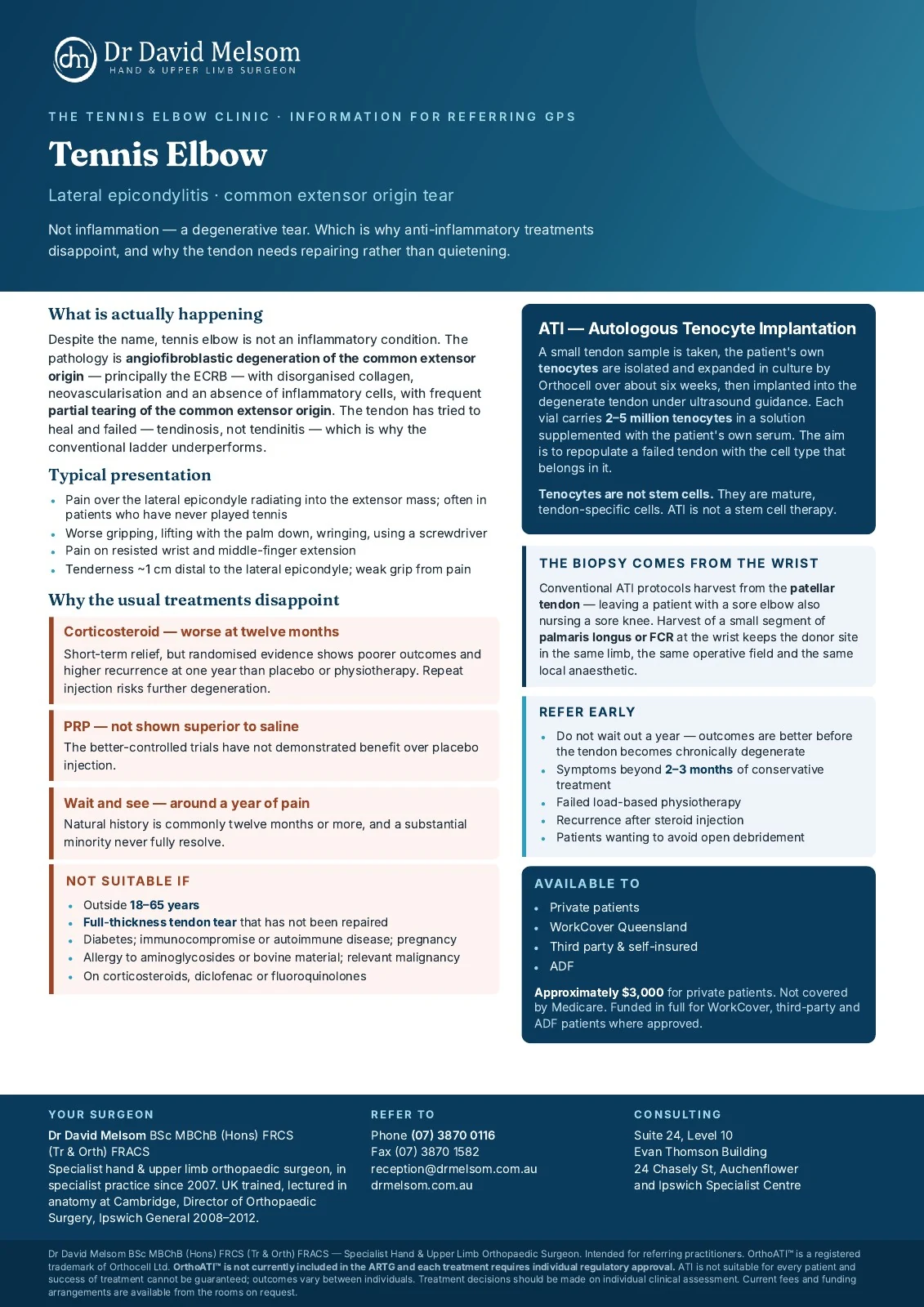 View the full information sheet PDF · Opens in a new tab
This practice information sheet explains the wrist-biopsy technique, referral considerations, suitability and indicative fees and funding. It is written for referring clinicians. Please confirm current fees and any WorkCover, insurer or ADF approval with the rooms; funding is not automatic. Your individual assessment and treatment plan take priority over general information in the sheet.
Surgery
Surgery is reserved for the small group of patients with severe symptoms persisting beyond 6–12 months despite proper conservative care. The degenerate portion of the tendon origin is debrided and the tendon repaired, either open or arthroscopically.
- Day surgery
- Return to light activities within a few weeks
- Grip strengthening progresses over 2–3 months
When to seek specialist review
If elbow pain is not improving after several months of appropriate therapy, or if there is doubt about the diagnosis (nerve entrapment and joint problems can mimic tennis elbow), a specialist assessment is appropriate.