
Arthritis at the base of the thumb
The trapeziometacarpal (TMC) joint sits at the base of the thumb and is one of the most common sites of osteoarthritis in the hand. It is a saddle-shaped joint that carries very high loads — every pinch, grip and twist passes through it. As the cartilage wears, patients typically notice pain at the base of the thumb with pinching, opening jars and turning keys, weakness of grip, and often a visible prominence at the thumb base as the joint subluxes.
The thumb base joint is also called the carpometacarpal joint (CMC joint or CMCJ). When symptoms persist despite non-surgical treatment and surgery is appropriate, options include TOUCH joint replacement and trapeziectomy with suspension arthroplasty.
Joint replacement with the TOUCH® prosthesis
For suitable patients, the base of the thumb can now be replaced rather than removed. The TOUCH® prosthesis (KeriMedical, Switzerland) is a dual-mobility implant: a cup is fixed into the trapezium and a stem into the thumb metacarpal, with a mobile bearing between them that allows movement at two interfaces. This design was developed specifically to address the dislocation and loosening rates that limited earlier generations of thumb implants. Because the joint is resurfaced rather than excised, thumb length, the natural mechanics of the joint and pinch strength are preserved, and rehabilitation is typically faster than after the traditional operation.
Example case — TOUCH joint replacement
Pre-operative — arthritis at the thumb base
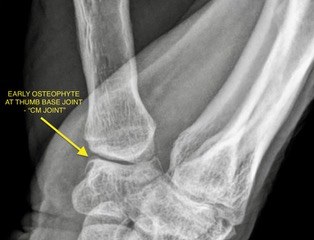
Radiograph demonstrating an osteophyte (bone spur) at the thumb base — the carpometacarpal, or “CM”, joint — a typical early radiographic sign of trapeziometacarpal arthritis.
Post-operative — TOUCH® prosthesis in position
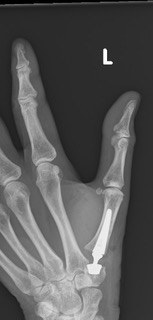
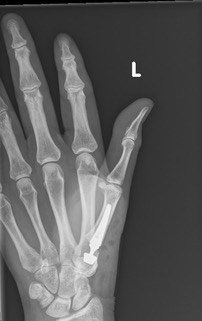
Radiographs following thumb base joint replacement with the TOUCH® dual-mobility prosthesis. The stem sits within the thumb metacarpal and the cup within the trapezium, with the length and alignment of the thumb column preserved — the feature that distinguishes replacement from trapeziectomy, where the trapezium is removed and the thumb column shortens.
Individual results vary; these images illustrate one example and are not a prediction of outcome in any particular patient.
Trapeziectomy with suspension arthroplasty
When TOUCH joint replacement is unsuitable and surgery is appropriate, trapeziectomy with Arthrex Mini TightRope® suspension arthroplasty is a standard option in Dr Melsom’s practice. The choice depends on your arthritis pattern, bone quality, examination and the demands you place on your hand.
What the operation involves
A trapeziectomy removes the trapezium, the small wrist bone at the base of the thumb, to remove the arthritic joint surfaces. Suspension arthroplasty, also called suspensionplasty, supports the thumb metacarpal after that bone has been removed.
The Arthrex Mini TightRope uses a strong suture secured by two small metal buttons between the thumb and index-finger metacarpals. This supports the thumb while the surrounding tissues heal. It does not replace the removed joint with a ball-and-socket implant. Arthrex’s explanation of the Mini TightRope technique.
Example radiograph — trapeziectomy and Mini TightRope
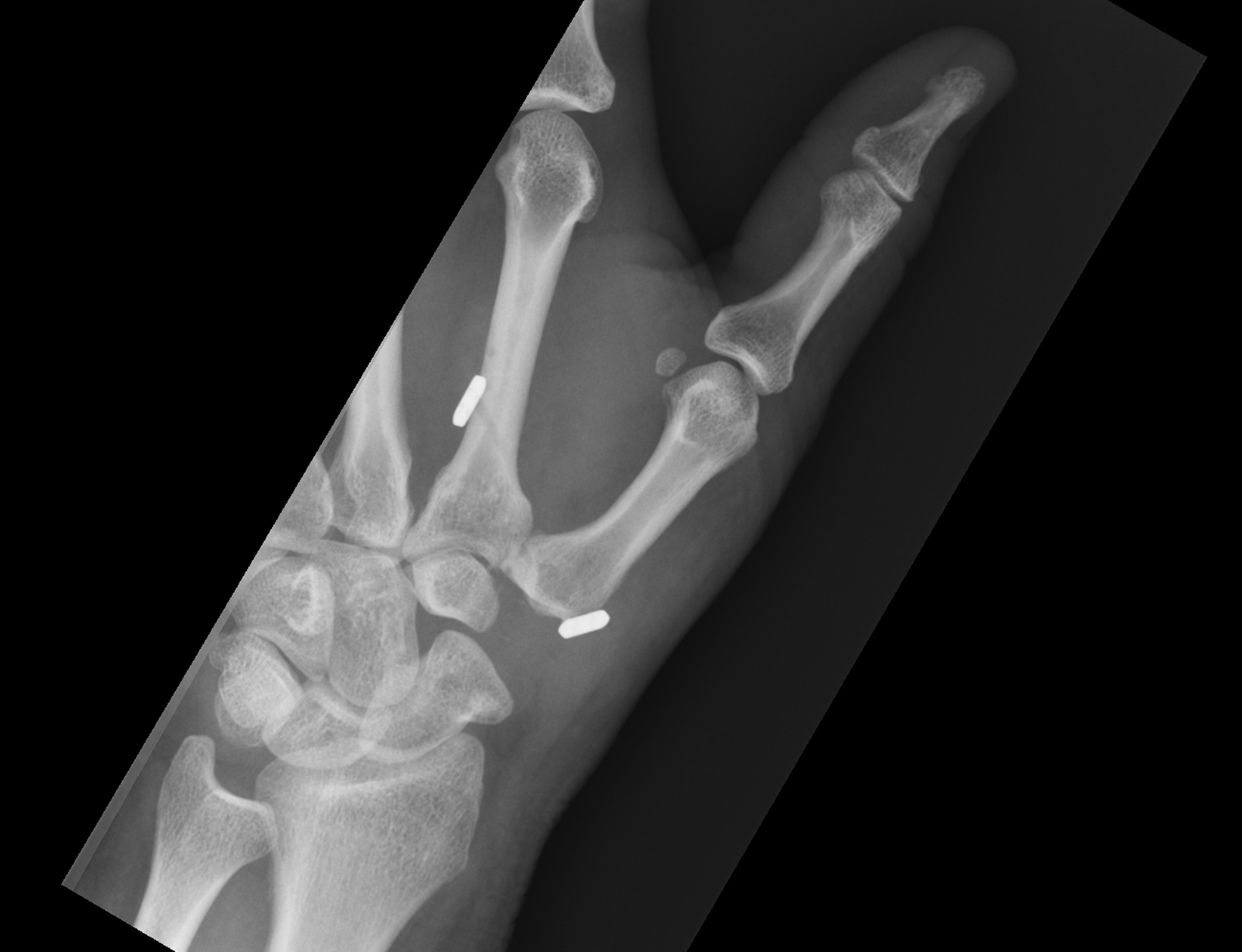
Thumb movement three weeks after trapeziectomy
Recovery and considerations
A splint protects the thumb initially. Hand therapy guides movement and the gradual return to grip and pinch activities. The suspension device does not mean the hand is ready for immediate heavy use: recovery continues over several months, and your splinting, strengthening and return-to-work plan are tailored to your operation. AAOS patient information on thumb CMC arthroplasty.
Possible problems include persistent pain, stiffness, scar sensitivity, nerve irritation and infection. Suture-button procedures also have device-specific risks, including irritation from a button, suture failure, a metacarpal fracture or settling of the thumb. Further surgery is sometimes needed. These risks and the alternatives are discussed before surgery; adding a suspension device does not guarantee a better result than every other form of trapeziectomy. Published suture-button study.
How the surgical options compare
Trapeziectomy — removing the trapezium bone, sometimes with a tendon reconstruction — remains a reliable and well-proven operation with a long track record, and continues to be the right choice for many patients. The trade-off is that it shortens the thumb column, grip and pinch strength recover slowly, and full recovery commonly takes several months.
Joint replacement offers a faster return of function and better preserved pinch strength, at the cost of introducing an implant, with the implant-specific risks that carries. Which operation suits you depends on your pattern of arthritis, bone quality, hand demands and expectations — this is a decision we make together in consultation.
What the evidence shows for TOUCH
Published results for the TOUCH® prosthesis are encouraging in the short to medium term:
- Function and pain improve substantially. In a prospective case series, median DASH scores (a measure of upper limb disability) fell from 54 to 12 at one year, and pain scores fell from 8 to 1 out of 10.
- Pinch strength improves, rather than being sacrificed — key-pinch increased from 3.8 kg to 5.8 kg in the same series.
- Complication rates are modest. Reported overall complication incidence is around 13%, with a dislocation risk of about 0.6% — substantially lower than older single-mobility designs, which is the principal advantage of the dual-mobility concept. A separate series reported 97% implant survival at four years with a 0.5% dislocation rate.
- Follow-up now extends to eight years. A prospective study of 61 TOUCH® prostheses followed for five to eight years reports that the implant is a safe and effective treatment for trapeziometacarpal osteoarthritis in the short and medium term, with patients assessed by an independent observer for pain, thumb range of motion (including Kapandji score), key-pinch strength and satisfaction.
- Larger series support this. A study of 150 dual-mobility prostheses at four years reported high effectiveness for pain, function and thumb stability, with low revision rates and restoration of thumb length and correction of hyperextension.
A fair note on the evidence: results out to eight years are encouraging, but this remains a medium-term evidence base rather than the twenty- and thirty-year data available for hip and knee replacement. The authors of the eight-year series themselves note that continued follow-up is needed to establish true long-term performance. That is the honest position, and it is one worth discussing before deciding on any implant.
Recovery after TOUCH replacement
The thumb is protected in a splint initially, with hand therapy beginning early to restore movement. Most patients are using the hand for light activities within a few weeks, with strengthening progressing over the following months. Your individual plan will depend on the quality of your bone and the fixation achieved at surgery.
Is it right for me?
Thumb base joint replacement is not suitable for everyone. Factors that matter include the extent of arthritis in the surrounding joints, bone stock in the trapezium, inflammatory arthritis, and the physical demands you place on your hands. The purpose of consultation is to work out whether replacement, trapeziectomy or non-surgical management best suits your particular thumb and your particular life.