
Arthritis of the wrist
Advanced wrist arthritis can follow a scaphoid fracture that failed to unite, a scapholunate ligament injury, previous trauma, or inflammatory arthritis. As the joint surfaces wear, patients describe deep aching pain, loss of movement and a wrist that will no longer take load — difficulty pushing up from a chair, carrying, or gripping firmly. Once the arthritis is established and non-surgical measures no longer control the pain, the decision has traditionally been between fusing the wrist or replacing it.
Wrist replacement with the Motec® prosthesis
The Motec® total wrist prosthesis (Swemac, Sweden) is a fourth-generation, cementless, ball-and-socket design. Screw-shaped components are anchored into the radius and into the metacarpal, and a modular bearing couples them. Two features distinguish it: it is bone-preserving — comparatively little bone is removed, which keeps future options open — and its ball-and-socket geometry allows movement in all planes rather than constraining the wrist to a single arc. Because fixation relies on osseointegration (bone growing onto the implant) rather than cement, the quality of that biological fixation is central to how the implant performs over time.
Example case
Pre-operative — arthritic wrist
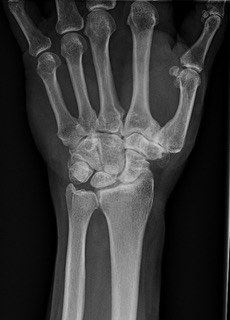
PA radiograph before surgery, showing the arthritic radiocarpal joint.
Post-operative — Motec® prosthesis in position
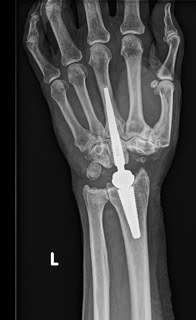
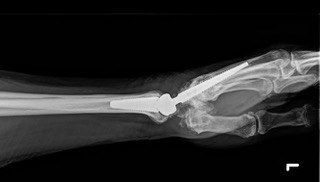
PA and lateral radiographs following total wrist replacement with the Motec® prosthesis. The screw-shaped components are anchored into the radius and the metacarpal, coupled by the ball-and-socket bearing. Note how little bone has been removed — the bone-preserving design that keeps later options, including fusion, available.
Individual results vary; these images illustrate one example and are not a prediction of outcome in any particular patient.
How it compares to wrist fusion
Total wrist fusion (arthrodesis) is the long-established operation for advanced wrist arthritis. It is dependable and durable, and reliably relieves pain — but it eliminates wrist movement permanently. For many patients that trade is acceptable; for those who need rotation and flexion for their work, hobbies or personal care, or who already have stiffness elsewhere in the limb, losing wrist motion is a significant cost.
Wrist replacement aims to relieve pain while keeping the wrist moving. The trade-off is that it introduces an implant which can loosen, wear or require revision, and it demands more of the surgical technique and of the patient afterwards. Fusion remains an option after a replacement, which is one reason the bone-preserving design matters.
What the evidence shows
The Motec® implant has a reasonable and growing evidence base:
- Survival at ten years is reported at approximately 86% — a strong figure among fourth-generation wrist implants. For context, other contemporary designs report roughly 78% at 15 years (Universal 2), 90% at 9 years (Re-Motion) and 95% at 8 years (Maestro).
- Movement improves. Published series report total active range of motion rising from around 97° to 126°, with grip strength improving from about 21 kg to 24 kg, alongside improved QuickDASH and pain scores.
- An international cohort of 171 wrists followed for a mean of 5.8 years reported a revision rate of 8.2% and a complication rate of around 19%.
- The commonest mode of failure is failure of osseointegration — the implant not bonding adequately to bone. Other identified causes include soft-tissue balancing problems, implant impingement, osteolysis and metacarpal fracture. Notably, several of these have been described as preventable with attention to technique.
Two honest points about this evidence. First, complication and revision rates in wrist replacement are meaningfully higher than we are used to quoting for hip or knee replacement — this is a smaller, more complex joint carrying high loads through a short lever. Second, the literature explicitly documents a learning curve with this implant, with outcomes improving as surgical experience accumulates. Both are things you are entitled to ask me about directly.
Recovery
The wrist is protected initially while osseointegration begins, with hand therapy guiding a staged return of movement and then strength. Loading is introduced deliberately and gradually — early aggressive use works against the biological fixation the implant depends upon. Heavy manual work and impact loading are generally discouraged long term, as they shorten the life of any wrist replacement.
Is it right for me?
Wrist replacement suits some patients and not others. Bone quality, the pattern and extent of arthritis, inflammatory disease, previous surgery and — importantly — the demands you place on the wrist all influence whether replacement or fusion is the better operation for you. Heavy manual workers are often better served by fusion. The purpose of consultation is to weigh those factors honestly and reach the right decision for your wrist.