
The problem with replacing a young shoulder
Shoulder arthritis in a patient in their forties or fifties presents a genuine dilemma. A conventional total shoulder replacement gives excellent pain relief, but the plastic glenoid component is the part that wears — and in a young, strong, active shoulder it wears faster. Loosening of that socket is the commonest reason a total shoulder replacement eventually fails, and revision surgery in a young patient is a significant undertaking with progressively less bone to work with.
The traditional alternative — a metal hemiarthroplasty, replacing only the ball — avoids the plastic socket, but metal articulating against living cartilage and bone can cause glenoid erosion, sometimes rapidly, producing pain that then requires conversion to a total replacement anyway.
What pyrocarbon changes
Pyrocarbon (pyrolytic carbon) is a material with an elastic modulus close to that of cortical bone — it is far more forgiving against articular cartilage than metal. It has decades of use in hand and wrist implants, and in the shoulder it is used as the head of a hemiarthroplasty: the arthritic ball is replaced, and the patient’s own glenoid is retained.
The appeal is what is not done:
- No plastic glenoid component — so no polyethylene wear and no glenoid loosening, the main long-term failure mode of total shoulder replacement
- Bone is preserved — later conversion to an anatomic or reverse total replacement remains straightforward if it is ever needed
- Lower risk of glenoid erosion than a metal hemiarthroplasty
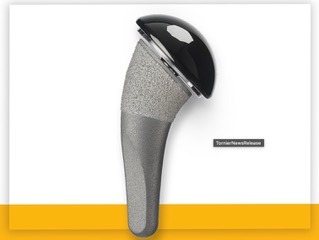
A pyrocarbon humeral head on a porous-coated stem. The dark head is the pyrolytic carbon bearing surface that articulates against the patient’s own glenoid.
Who it suits
Pyrocarbon hemiarthroplasty suits the active patient with a functioning rotator cuff and good bone stock, in primary or secondary shoulder osteoarthritis. The published series centre on patients aged around 60 and under, but chronological age is not the deciding factor — biological age, activity level and demands matter more, and the operation is appropriate for selected older patients who remain fit and active.
Nor does glenoid deformity automatically rule it out. Significant retroversion can still be managed with this implant in the right shoulder, and is assessed individually rather than treated as a fixed cut-off.
It is not the right operation for cuff tear arthropathy or an irreparable rotator cuff — those shoulders need a reverse total shoulder replacement. For a lower-demand patient, a conventional anatomic total shoulder replacement remains highly reliable.
What the evidence shows
The published results in this specific population are encouraging:
- Revision-free survival of 94% at five years and 89% at ten years, in a prospectively followed series of 96 patients (103 shoulders) with a mean age of 56.
- Function improves substantially — adjusted Constant score rose from 43% to 97%, and subjective shoulder value from 38% to 84%.
- Return to activity is the striking finding. In that series all patients returned to sport, and 84% of working patients returned to work — which is precisely the outcome this group of patients cares about.
- Authors describe it as an alternative to metal hemiarthroplasty (avoiding rapid glenoid erosion) and to total shoulder replacement (avoiding early glenoid loosening) in active patients, with low rates of glenoid erosion and revision at two to ten years.
A fair caveat: this is a medium-term evidence base in a selected population. Ten-year data exists, but not the twenty- and thirty-year figures available for conventional shoulder replacement, and results depend heavily on choosing the right patient. That selection is the most important part of the operation.
Recovery
A sling is worn for comfort in the early weeks, with physiotherapy restoring movement before strength. Because the rotator cuff must be respected during healing, strengthening is introduced deliberately. Return to sport is realistic in this group, but is staged over months rather than weeks.
Is it right for me?
The honest answer depends on your activity level and demands, the state of your rotator cuff, your bone stock and the condition of your glenoid — assessed together rather than against any single threshold. The purpose of consultation is to establish whether preserving your own socket is achievable and durable in your particular shoulder, or whether a conventional replacement will serve you better.